Showing posts with label fire. Show all posts

Tuesday, May 22, 2012

Meanook in Song


In the chill of the evening, the passerines are active with the sun still several hands high.  Tennessee Warblers dressed in yellowish green have invaded en masse and flit from tree to tree.  They are mistaking windows for pass-throughs much to the dismay of everyone here at Meanook.  One such warbler, recovering on a pine branch, finally flew off, but only after Kitten made leaps for it, pulling the bough low as if he was the one hanging on for dear life.  Hooray for the bird.  No doubt Kitten will find a snack elsewhere this evening but the warbler flies free.  White Throated Sparrows are chatting with the Chickadees and the rowdy Ruby Crowned Kinglets, the Blue Jays yell and swoop from low branch to low branch, and the Sapsuckers play percussive wood.  It is a symphony in the bush. 

Spring is arriving here with birds and blooms.  The cherries aren’t quite flowering yet, but they are knocking on that door.  It seems spring is a little early up here as it is also on the east coast.  Last year almost to the day, it snowed 5 inches.  Two days ago I was hot and sweaty looking at a collapsing permafrost mound. 

Our research puts us in what is called the discontinuous permafrost zone.  North of us, the earth is frozen year ‘round.  South of us, the soil thaws completely every summer.  Here, there are pockets of frozen mixed in with the thawed.  This zone is shifting northward and that thaw brings changes to the landscape and changes to the ecosystems.  Fire hastens this advancement, warming the earth as it scorches it with no chance of the peat recovering the cold of the next winter.  Last year was a doozy on the fire-front, and this year, seems like we are in for another.  Right now, 23 fires burn in Alberta with 345 fires since the burning season started this spring.  We drive through smoke on the way to our sites.  That acrid burn in the nose is not unfamiliar to us and puts me on edge.
Tomorrow we head north to the Mariana Lakes region of Alberta where we will spend the day in both bog and fen and hopefully not run into any bears or fire.  The travel allows for some fast truck window viewing, and since arriving, we’ve seen much:  a Bald Eagle, an Osprey, countless waterfowl and shore birds, Sandhill Cranes, Buteos, Falcons, Shrikes, Passerines of all shapes and sizes.  Our feathered friends are here and are welcoming us to Alberta and to spring.  The morning will bring the dawn of a new day and as we walk among the mosses the birds will sing.


Note:  The above was written 2 days ago… the total fires is now up to 390 as of 10 AM yesterday…   much potential for ignition.   We have only experienced a bit of smoke and smoldering.  So far so good.  More soon.

Saturday, December 10, 2011

Phoenixville Firebird Burning Bright


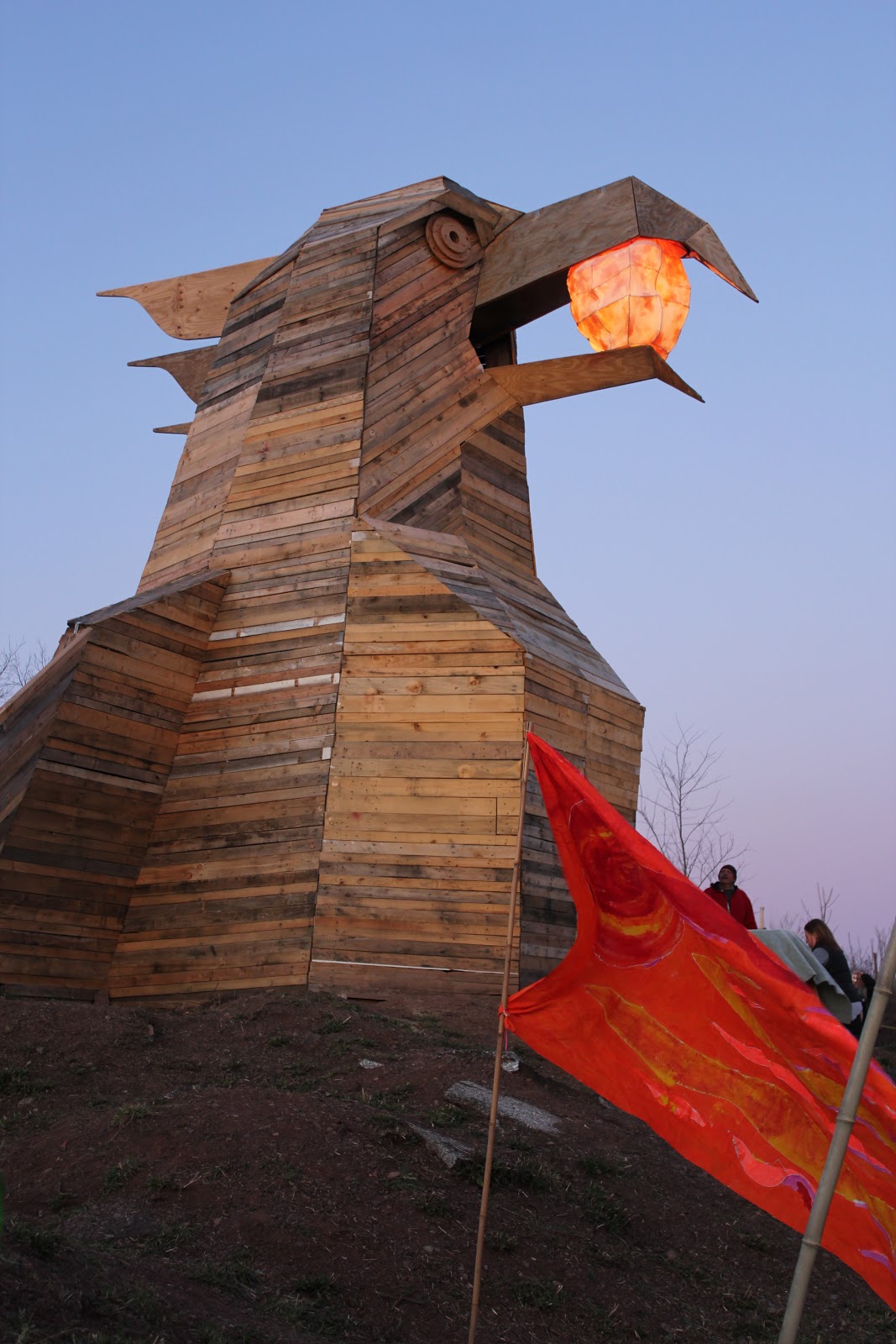
 Phoenixville burns with creativity.  I have been a fan of my little town since I moved here; and it just keeps getting better and better.  You gotta’ love a town that every year builds a wooden structure in an open town space for all to gather ‘round as they set it on fire (the fire department is out in force just in case).  I would wager other communities have something similar, but around here, there is nothing like it.  Tonight, the firebird burned brightly and brought the masses out in the cold winter weather.

My first festival involved only a few hundred people, a wobbly wooden structure, and was many years ago when I first moved to Phoenixville. Tonight:  Thousands of people showed and that bird was SOLID.  Three stories tall, it held a glowing ball in its beak in the waning light and the crowd was massive.  I’ve never seen so many people in Phoenixville.  Chants began about 30 minutes before the lighting:  Burn the Bird – Burn the Bird.  The excitement was contagious.

With Vega resting behind the bird, the flame arrived from its march through town and the bird was ceremoniously set on fire.  I was right up close there with the best of them and once that thing started throwing flames, we were no longer cold - in fact, it was HOT.  Heat radiated from the beast and ash and embers began to fall on the crowd.  No one seemed to mind and I was happy to have my hat on so I could concentrate on the fire instead of protecting my brain from burning debris.
 
As the bird fell in pieces and toppled inwardly, the crowd cheered and drums sounded.  It was a very primal experience in the middle of a town in Eastern Pennsylvania.  Great job Phoenixville!  Way to ring in the season of light.

Thursday, October 13, 2011

Smoldering Earth

 
Meanook still smells of smoke from the fire that decimated the lab building.  Rubble is piled high and bits and pieces of our past field work poke out of the ash and blackened bits of twisted debris.  Cinder blocks are scattered around the periphery and if you look closely, you can still find decapitated scales, melted volumetrics, and sample bottles filled with tainted bog water.  Burned and dented freezers, drying ovens, and water systems are sunk like monoliths in the pile of deranged metal.   Many items are still identifiable and yet completely ruined and that just makes it worse.  It is not just a pile of burned unidentifiable mess of destruction.  It is Our mess of destruction and it is sad to see.

After about 30 minutes of poking around, I needed to find something of beauty to hold onto and if you look closely, beauty is there hiding in color and texture...  

It turns out that there was a reason it still smells of smoke: the berm of earth between the debris and the woods remained silently secretly smoldering now for two weeks post fire.  The electric company came today to restore our power, and in putting in a new pole, found smoking earth when they dug their hole.  Katy and I became temporary fire-fighters with a small hose and an enthusiasm for fire containment.  The Colinton volunteer fire department soon relieved us and took a shovel and hose to the hillside to finished her off.  Hopefully, we are now fully fire-free and smoke-free and with electricity as an added bonus.  It is nice to be rid of the constant yell of the generator reminding us of the piles in the parking lot.

Hopefully, they will rebuild, and in the spring, we will have a new space in which to work, but for now... the piles of depressing rubble remain.

Sunday, June 12, 2011

Fire Info Update and Resources


http://rapidfire.sci.gsfc.nasa.gov/gallery/ with overlay KDS
Changing gears a bit, a quick touch back on the fires that burn still in Canada.  Some folks back home in the States have been asking about the fires up north because there is nothing in the news down here --  we in the states are very “us” centered.  To be fair, the same can be said of Canadians.  It is what it is.  It has been important to me because it affects me, but understandably, it is way out there and so chances are good, you probably aren't so interested which is ok, but for those of you who are, here is a bit of info.

The reality is that wildfires up there are a way of life and threaten mostly wildlife and wildland a generous amount of time.  This year was an exception with a several towns under threat or burned.  The firefighters don’t always get things under control in time, but they do a great job, and are exceptionally busy right now.  Fires are cyclical and this year is a rough one in Alberta.   I work in an ecosystem that has evolved with consistent fire return intervals and we have learned to expect fires to cycle through an area at least every 100-120 years or so and so it wasn’t a surprise that I was asked the question when our site burned:  didn’t I “expect the muskeg (local for peatland) to burn?”  Yes, fire is a way of life up there, but it is no less dramatic for being so.  That site didn't make it 100 years and we still have sites on the fringe of this large fire to the north. 

Natural Resources Canada is a wealth of information about fires in Alberta and all across Canada.  Already Alberta is way over the 10 year average for area burned even though the number of fires is less than the average (http://fire.cfs.nrcan.gc.ca/firereport/graph-eng.php#gr1).  The fire that threatened our sites north of Fort McMurray has now burned over 561,000 hectares of land (some of which are now burning underground).  The image up and to the left shows active hot spots four days ago - the larger open circle of red dots is the fire north of Fort McMurray and it is burning from the center outward and so the entire area within those dots has been burned.   As of this morning with the fire still out of control, over 2168 mi² has burned with this fire alone.  To give you some perspective, this is larger than the land area of Rhode Island (1,044.93 mi2) and even Delaware (1,953.56 mi2).  The fire in Arizona is out of control at less than a third of the size of the fire burning in Alberta (600 mi2 http://www.dailymail.co.uk/news/article-2002247/Wallow-Fire-Arizona-blaze-set-states-worst.html?ITO=1490).  In no way am I minimizing the fire in Arizona as it is affecting vastly more people than the one of which I speak in Alberta (and over half the size of Rhode Island has burned already there- that is big big big).

Smoke from Alberta has been blowing into Saskatchewan to the east (Saskatchewan is now threatened by many fires independently), as well as south and even west and into the US (http://cimss.ssec.wisc.edu/goes/blog/archives/8161).   If you are into GIS/Google Earth stuff, check out NASA’s stuff – they have a lot… a jumping off spot includes the MODIS Rapid Response System http://rapidfire.sci.gsfc.nasa.gov/firemaps/ and the USDA has great stuff for both US and Canadian fires (http://activefiremaps.fs.fed.us/googleearth.php?sensor=modis&extent=canada) and is source of this Google Earth image above.  They have a host of KML files at the ready.

One thing is certain...   if this fire encroaches on the Oil Sands area shutting down oil production and affecting the US by creating a scenario with increases in oil and gas prices, we surely will begin to pay attention.  Huge efforts were made to force the fire from the southern boundaries where more industry and human activity dominates.  As you can see from the image at the top of the page, the fires are now burning mostly on the west and east sides further north and that is good news for the oil companies and for the folks still in Fort MacKay who haven't evacuated.  The big oil companies were nervous.  This map on the right was generated by the government of Alberta and if you feel like following the chatter, you'll find a wealth of information on the Alberta Wildfire Info Facebook page (http://www.facebook.com/pages/Alberta-Wildfire-Info/357885625988).  

The world is burning and is bigger than NBC10 can communicate.  Earthquakes, tornados, floods, fires, heat-waves, droughts….   It is only the beginning of June and for now, the fires still burn.  

Wednesday, May 18, 2011

Fire Continued

image courtesy of NASA-EO
Brief update…  Fires are still burning.  We are fairly sure that our site (our major site with equipment, etc) is toast and the roads north of Slave Lake to our sites are still closed as fires still rage.  No one knows when they may be open again or when the fires will be contained.  I believe that is up to the weather and the diligent efforts of firefighters….  More sites in Fort McMurray may potentially be in trouble as a very large uncontrolled fire burns east of our site near the town of McKay.  McKay is being evacuated of folks with respiratory problems.  Smoke is thick there and Oil companies are evacuating processing plants that are in the line of smoke and fire.   No rain yet, just more hot and more wind.  Ironically, the bugs are now wicked as the heavy snow and ice melt here have the wetlands all brimming with water and bugs.  The uplands, on the other hand – dry as a bone.

Smoke came back with a vengeance last night ‘round midnight, 1 AM….   My eyes are burning and tired.  Seems ok now, but I can’t imagine what the firefighters have to deal with.  Here, it is just brief bits of smoke now and again.  

We are off to haul lumber into our fen site two hours north of here on the way to Fort McMurray – interestingly it is a fen surrounded by burned upland.  We just cleared a path there yesterday to get some quads in and I was a mess – full of soot and fine black powder.   Hard to imagine what walking through a fresh site will be like, but I’ll let you know once they let us back in….

Tuesday, May 17, 2011

Wildfires


And so here I was with a happy little ditty on Fort McMurray and field work and corn nuts all flippantly written up, only to get back to Meanook yesterday from our first expedition (the field station) to learn that basically, the world was on fire.  I’ve grown accustomed to hearing about all of the flooding problems in the US and Canada, but now it is only wildfires on everyone's lips here.

It is interesting to get a new perspective on things now and again and that plays out nearly every time I head to the research station here in Alberta.  I’ve learned that they don’t realize it is flooding in the US and we have no idea it is flooding in Manitoba, either.  They cheer only now for Vancouver to win the Stanley Cup.  For the most part, we could give two flying flips about who wins.  We go about our lives not worrying about wildfires while they are losing everything to the beasts.  If it isn't water, it is fire it seems, here. 

Fire has broken out everywhere in our area and it seems the whole province is on fire depending on who you talk to.  Reliable detailed information is surprisingly difficult to find.  What we do know is that Slave Lake – population around 7000 was evacuated yesterday only very late in the day.  Fires were around the town and fires are fairly common here and so they know what they are doing with the whole firefighting thing.  They weren’t terribly worried and thought they had the fires contained, but Mother Nature decided to bump up the winds to 70-100 kms/hr fueling the fires;  and by the evening, citizens were being told to find large parking lots and to get as close to the lake as possible.  The fires had surrounded the town.  The three roads in and out of Slave Lake were impassable and everyone was trapped.  They got one road open in part with the use of guide trucks forging a flashing trail through the dense smoke and have since safely evacuated everyone.  The fire still burns, but according to the most recent news report, 40% of the town is cinders.

Athabasca, the small town closest to Meanook is now helping hundreds of refugees who are bunking in the local indoor soccer gym…  600 people and their pets have found a home here for now – just a two hours drive from Slave Lake.  More have been sent along toward Edmonton as we cannot house them all, and south is the only way out.  The roads and town are still not accessible.  Winds have died down, but fires still rage out of control.  Fires have sprung up to the east, north, and west of us and smoke permeates the air here at the field station.  I was supposed to lead a group to do some field work at a site we have near Utikuma Lake tomorrow (north of Slave Lake) and have Zero hope of doing so.  There are literally hundreds of hotspots surrounding the roads we must travel and I give it a good percentage that at least one of our sites has burned and no longer even exists as we once knew it.  Ironically, it was once one of our “fire sites” where we studied carbon cycling in bogs based on age of bog…   perhaps we have just reset the clock.   What this all means to us here at the field station remains unclear and the fickle finger of Mother Nature will keep us on our toes for quite some time, I believe.  The helicopter we hired to load equipment into our new site is now being used to fight fires elsewhere and is indeterminately unavailable.  I see a lot of walking with a lot of heavy stuff for a lot of people in our very near future.  Not until a soaking rain, will these fires all be doused.  I am not holding my breath.   I will be heading into the cinder zone as soon as possible, but for now, it is solidly off limits.   We hope for containment for all the fires everywhere here and for now Meanook is smoky but not in the line of fire. 

Be safe wherever you are.  I will keep you updated.